How Does Existential Uncertainty Impact our Mental Health, Wellbeing and Collective Abilities to Manage Global Crises?
We are facing several global crises – from climate change through political polarisation to a growing number of war conflicts. These crises are intertwined and underpinned by the deepening crisis of democracy. However, the role cumulative negative emotions play in these crises is rarely acknowledged. Some recent research suggests that an increase in negative emotions over the last two decades predicted the increase in populism which is significantly contributing to democratic decline. There is also research evidence suggesting that greater political polarisation is linked to higher rates of depression, anxiety and stress. So the current mental health and wellbeing crisis is further interwoven with the causes and consequences of these societal crises.
The newest stream of my research aims to deepen our understanding of the links between mental health, wellbeing and global crises. The particular focus of this research is on possible ways to break the vicious cycle of negative emotions, polarisation fueled by social media and democratic decline that limits our collective ability to address global crises. In this work I am building both on my new framework of psychological and neuro-cognitive capacities underpinning mental health and wellbeing and our research in neuroscience of meditation.
For example, some of the research in my lab is examining whether mental health and wellbeing capacities such as our ability to manage emotions or sense of connection to others and engagement in prosocial actions can protect wellbeing in the face of the global crises. We are also examining if these capacities may increase pro-environmental attitudes and environment-friendly action. Other research is exploring links between these capacities and political polarisation.
And research in psychology and neuroscience of meditation is relevant to solutions to the global crises too. The main line of our research is particularly looking at links between different states of awareness, political polarisation and sustainable behaviours. This is because solutions to the global crises may require ‘deeper shifts’ in our sense of self and ways we perceive ourselves in relation to others and the world. For instance, political polarisation often targets the very core of our self-identity, our sense of values and belonging to groups and ideals. And sustainability is intertwined with our perceptions of ‘how much of what’ we need to live a good and fulfilling life.
I will be sharing more on our research on existential uncertainty in my upcoming blog articles and a new podcast on ‘Dealing with Existential Uncertainty’.
Accessible articles:
What is the best realistic future for humanity you can imagine? I think this is a question we all need to start asking from time to time. Otherwise, we may find ourselves joining a ride to an unknown destination and being regularly offered lots of different tech gadgets as a distraction from questioning where we are going… In the first article on my new Substrack I introduce Logofuturisms: An alternative to technofuturism and other isms
In this article on my Psychology Today blog I explain why our wellbeing is intertwined with how strong democracies are and suggest what we all can do at the individual level to support democracy. This includes using fear as a compass, fostering our shared humanity and taking constructive action. Read more: Fear Can Undermine Democracy
This article – Existential uncertainty: how it affects your mind – and what you can do about it – published in The Conversation explains the effects of existential uncertainty on our mind and brain. It also outlines practical strategies we can use to manage these detrimental effects and instead engage is actions that support cooperation and help us find solutions to the crises.
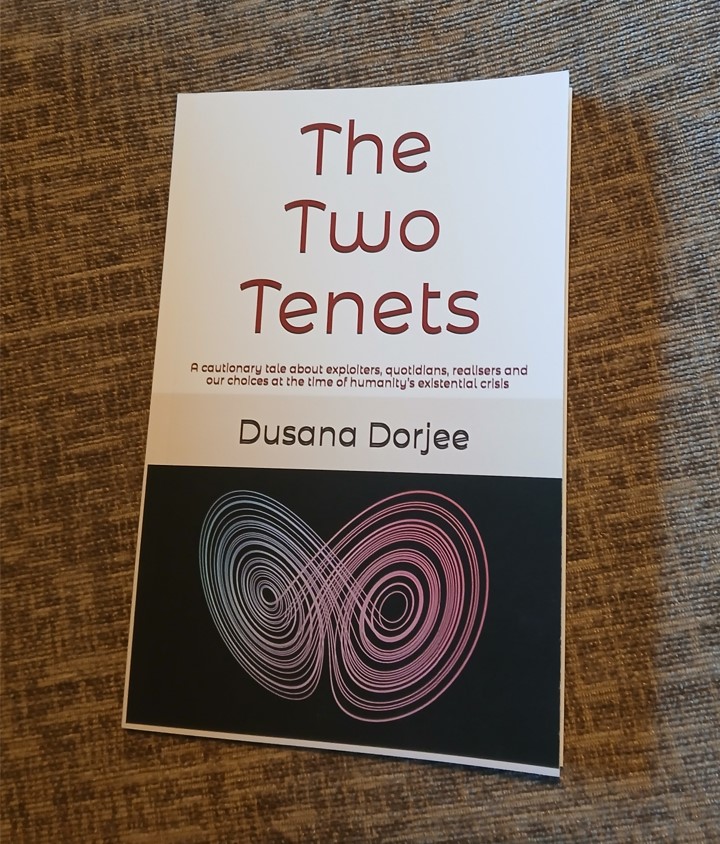
Fiction book:
Sometimes we need metaphors to enable clarity of understanding and to inspire constructive action. The Two Tenets is my first fiction book, a novelette, exploring two possible scenarios of global events unfolding in the next six years. The book exemplifies how our individual and collective actions might determine whether we follow the path of self-destruction or the path of self-knowledge and greater good. The book builds on some of my research on the topic of existential uncertainty.
Upcoming podcast:
Logofuturism